Four Questions to Tell a Useful Perfume Review from an Ad
Someone else’s impression does not have to match yours. The value of a review lies elsewhere: it helps you understand the conditions in which a fragrance was encountered and separate the writer’s observations from promises.
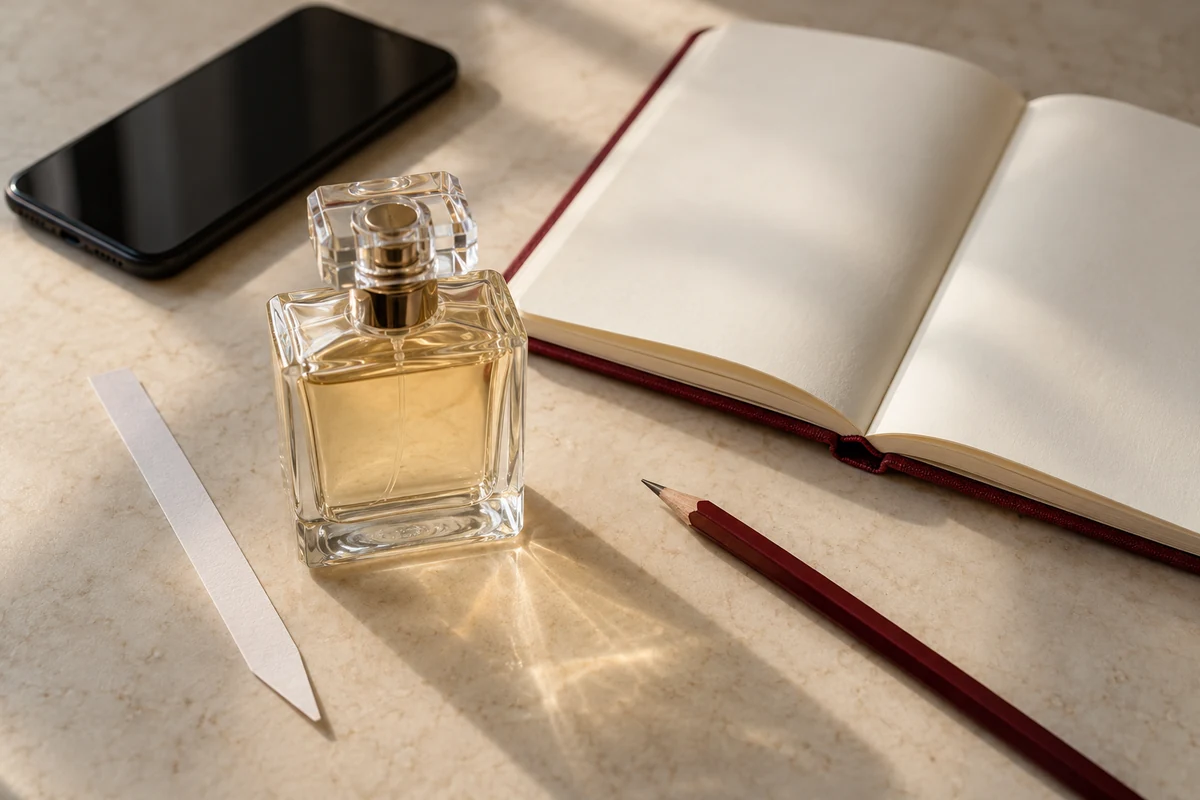
An enthusiastic video about a new bottle can easily feel like ready-made advice. Yet every review brings together the composition itself, the way it was applied, timing, expectations and the reviewer’s individual sense of smell. Treating such a story as one person’s experience makes the noise around a fragrance easier to filter out.
Look for context first
Words such as “long-lasting,” “quiet” and “too sweet” are useful only with details. How many sprays did the author use? Did they smell the fragrance on a blotter, skin or clothing? Had ten minutes passed, or a full day? A dense amber extrait and a light citrus cologne call for different expectations of longevity.
A precise reviewer separates observation from recommendation. “After an hour, a woody base remained on my skin” describes a specific situation. “This fragrance will suit everyone in the office” already calls for caution. The clearer the conditions, the easier it is to relate someone else’s experience to your own.
| In a review | What it may actually mean | What to clarify |
|---|---|---|
| “Very loud” | The author noticed the fragrance at a distance or in a room | Dosage, format, weather and distance |
| “I can’t smell the advertised note” | The note does not register for this nose or at this stage | When the fragrance was smelled and what it was compared with |
| “It lasts all day” | The fragrance’s trail or base remained noticeable for the author | Where it was applied and who could smell it |
| “It resembles…” | The author detected a familiar device or mood | Whether the specific notes and development truly overlap |
Disclosure adds essential context to a review
A gifted bottle, paid partnership, affiliate link, discount or invitation to a presentation creates a commercial connection. FTC guidance and EU consumer-protection rules require such relationships to be clear to audiences, as they may affect how a recommendation is perceived.
Disclosure does not in itself make a piece insincere. It simply means the review is worth reading more closely: does the author name the fragrance’s limitations, explain who may not enjoy it, compare it with other compositions and retain a critical tone alongside the praise? The absence of disclosure does not prove independence either—it only leaves the reader without part of the context.
What should raise caution is an advertising formula in place of a description of experience. Phrases such as “everyone will compliment you,” “perfect for every occasion” and “smells expensive” promise a desired outcome but say almost nothing about the scent. Details about discernible materials, the composition’s development and its limits are far more useful.
Someone else’s skin cannot predict yours
A perfume formula meets an entire set of conditions: an individual body odour, temperature, skin hydration, clothing and time. Research into the interaction between perfume and individual body odour shows that different people may perceive the result differently. Individual differences in olfaction also affect the recognition of scents and nuances.
That is why “it turned metallic on me” and “it unfolded into creamy vanilla on me” can both be honest impressions. Categorical claims that a particular note is “definitely present” or “definitely absent” are especially unreliable: in a complex composition, one person notices iris while another hears only dry woods.
Reviews can still offer useful reference points. Look for observations that recur among writers with different tastes and testing conditions. If several independent descriptions agree on a dry tea note at the opening and soft musk in the base, you have a map of the fragrance’s character. A split between “cosy” and “stifling” is more likely to point to personal taste.
Four questions before buying
- What exactly was tested? The name, concentration and version matter: a reissue, limited edition or same-named flanker may smell different.
- How is the fragrance’s development described? A useful review distinguishes the opening, development and base instead of blending all the listed notes into one inventory.
- What limitations does the author name? “I love rich vanilla, so I enjoyed it” is more valuable than universal approval because it immediately reveals the reviewer’s taste perspective.
- Why is there a link or promo code? A benefit does not invalidate personal experience, but it helps you judge its weight correctly.
Build your own picture
There is no infallible reviewer. Compare several reviews: one from a writer whose taste is close to yours, one from someone with opposite preferences and one who describes testing conditions in detail. The overlaps will outline the composition, while the differences will reveal its potentially divisive sides.
Then compare recurring traits with what you want. If different writers mention spicy saffron, dry leather and a powerful trail, while you are looking for transparency, you can draw a conclusion before meeting the bottle.
A good review leaves room for disagreement. It helps you understand in advance what to look for in a fragrance, which qualities may become tiring and where the composition ends and the reviewer’s personal impression begins.
Scents in this story
Mentioned in the story · ULNAY encyclopedia data
 BenefitRing My Bella
ringmybella opens in a clear floral sweep of lily, rose and daisy. Peony and jasmine expand the bouquet without disturbing its fresh, open character, while musk and vanilla soften its edges. Patchouli gives the base a quieter sense of depth, leaving the flowers bright yet gently grounded.
Open in encyclopedia BenefitSo Hooked on Carmella
Rhubarb, lemon and grapefruit bring a brisk, tart opening before tiare flower, cyclamen and peony soften the edges. Vanilla and amber lend sweetness and powdery warmth, while sandalwood gives the drydown a smooth woody line. The result balances brightness with comfort without losing its sense of air.
Open in encyclopedia BenefitLaugh with me Lee Lee
A cool rush of melon and citrus is sharpened by the green nuance of currant leaf and bud. Lily and jasmine bring an airy white-floral presence, with violet adding a softer floral shade. Sandalwood, woody notes and amber lend calm depth without obscuring the fragrance's fresh, lucid character.
Open in encyclopedia BenefitUnder My Spell Noelle
Cardamom and pepper open with aromatic heat, cut by the tart brightness of cranberry. Vanilla softens a floral heart of rose, orchid, violet and jasmine, while oud, patchouli and benzoin deepen the base. Raspberry adds another vivid berry accent to the warm, sweet and shadowed composition.
Open in encyclopedia
Share this story
Discussion
0 commentsComments use your ULNAY account.
Sign in to comment
It is quiet here. Start the conversation.