The Milky Accord: How to Describe Scent Through Texture
Words like “creamy,” “airy,” and “powdery” feel almost tactile, even though they describe scent. The language of texture can bring a milky accord into sharper focus—especially when the name and bottle offer no clues.
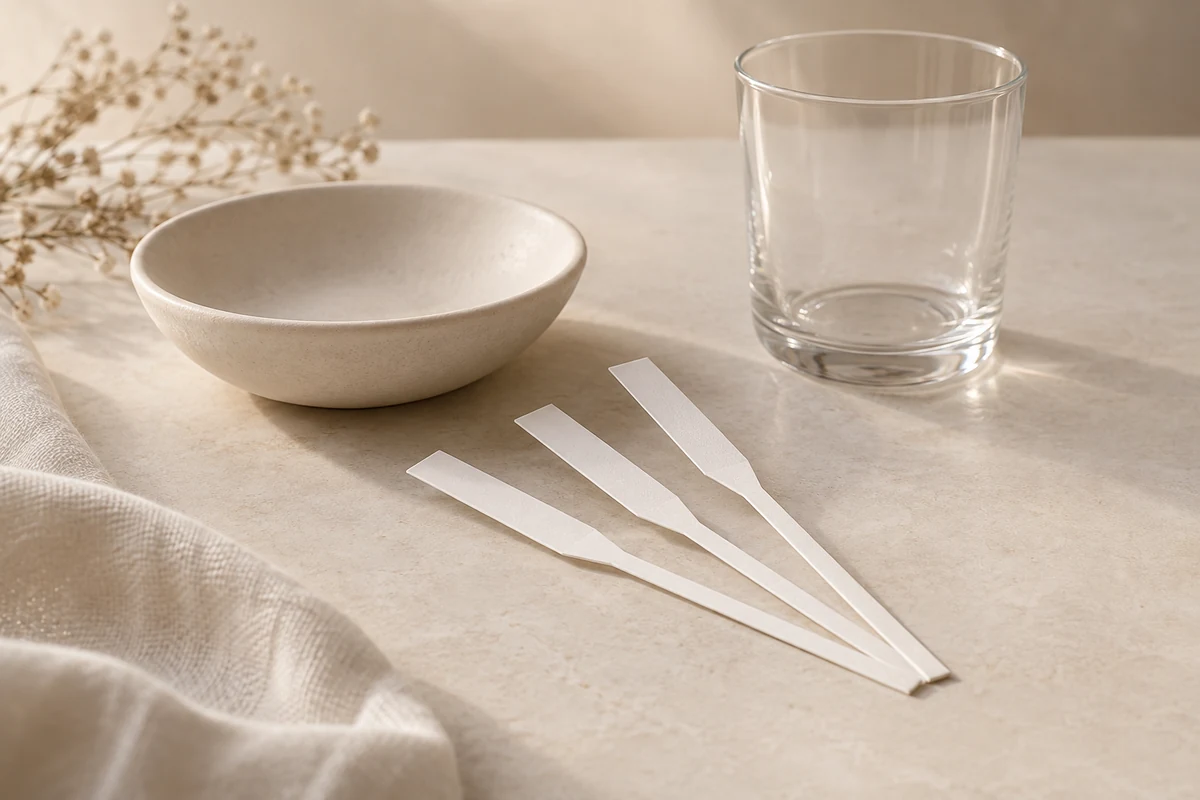
Identical paper strips marked with neutral codes lie on the table. With the brands and note lists concealed, the usual reference points disappear: the fragrances must be described through direct sensation—as warm cream, dry powder, whipped foam, or smooth wood.
That is the value of blind evaluation. It does not turn perception into an objective measurement, but it reduces the influence of packaging and preselected language. Research shows that even a simple label can alter how people judge a scent, including its pleasantness and intensity.
A Scent You Want to Touch
Smells are difficult to name directly. Someone may not recognize a specific material, yet still feel quite certain that it is smooth or rough, dense or transparent. This is why comparisons with fabric, cream, dust, or air can be more useful than a long list of notes.
These sensory crossovers are more than decorative language. In experiments on crossmodal associations, participants linked different smells with particular surfaces: caramel, for example, was more often perceived as smooth, while onion was considered rough. These choices are shaped by the character and intensity of a smell, how pleasant it seems, and the familiar everyday images it evokes.
The milky accord is particularly suited to this vocabulary. The word “milky” suggests less about composition than about a fragrance’s expected shape: rounded, soft, and free of sharp edges.
Milkiness Without a Glass of Milk
In perfumery, a milky effect is usually created through composition rather than a literal impression of fresh milk. Lactonic materials, soft woods, musks, vanilla, and floral nuances may all play a part. One such material, Methyl Laitone, is described as creamy, lactonic, and reminiscent of coconut milk; it can also add volume to sandalwood, floral, and fruity accords.
This leads to an important distinction: a lactonic fragrance does not have to smell like milk porridge. It may lean toward coconut, peach flesh, warm wood, or body cream. The recognizable sensation emerges from a combination of materials and changes with the formula as a whole.
Creamy, Airy, and Powdery
A fragrance is usually called creamy when it has noticeable density and smooth transitions. Its sweetness is not sharply separated from the rest; instead, woody, fruity, and musky tones seem blended into a uniform whole. The result may recall cream, soft butter, or melting ice cream without smelling like a dessert at all.
Airiness works differently. It is a sense of space between the notes: the fragrance does not press down as a solid mass, it lets in light and moves quickly from one shade to another. Here, milkiness feels more like foam or a light cloud than heavy cream.
Powderiness brings dryness and a matte surface. It is often associated with iris, violet, heliotrope, and certain musks. IFF’s professional description of an iris ingredient combines a powdery character with a velvety texture and violet facets—a useful example of scent taking on an almost tactile dimension.
These qualities are not mutually exclusive. A fragrance can open with airiness, become creamy, and settle into a haze of dry powder. This is why a single word written down immediately after applying a scent to a blotter rarely captures the entire composition.
How to Conduct a Fair Blind Evaluation
For an intimate tasting, three or four fragrances, identical paper strips, and a room free from stray odors are enough. Code the samples and reveal their names, notes, and promotional descriptions only after everyone has finished writing. Until then, it is best not to discuss impressions aloud: someone else’s vivid metaphor can easily become the group’s shared answer.
The first response should remain open-ended. Each participant records their own image before placing the fragrance between several opposing qualities: liquid or dry, smooth or grainy, dense or airy. If the only choices offered from the outset are “creamy,” “airy,” and “powdery,” the result will reflect not just the scent itself but the force of the prompt.
It helps to return to the strips after some time has passed. The volatile opening notes fade, and the composition may feel different. Discussion begins only after the final notes have been made, revealing which associations arose independently and which remained vivid personal images.
A small group cannot establish universal definitions. It can, however, reveal the living vocabulary of particular people: creaminess may remind one person of cold milk and another of coconut flesh or smooth sandalwood. These differences are not errors; they are part of the result.
Why Fragrance Needs Texture
According to Spate, gourmand compositions and quiet fragrances that sit close to the skin remain among the notable directions for 2026. A milky accord can sit at the intersection of these tastes, smelling edible and rich or nearly weightless, like a soft layer of musk.
Textural language helps clarify this distinction even before the conversation turns to favorite notes. A general fondness for “milky scents” becomes a more precise preference: rich cream, dry cosmetic powder, or translucent foam.
When the bottles are finally revealed, the official note pyramid becomes a second layer of interpretation rather than a ready-made answer. The most valuable thing has already happened: the fragrance has acquired a shape discovered through one’s own sense of smell.
Scents in this story
Mentioned in the story · ULNAY encyclopedia data


Share this story
Discussion
0 commentsComments use your ULNAY account.
Sign in to comment
It is quiet here. Start the conversation.