AI in Fragrance Creation: Reality or Futurism?
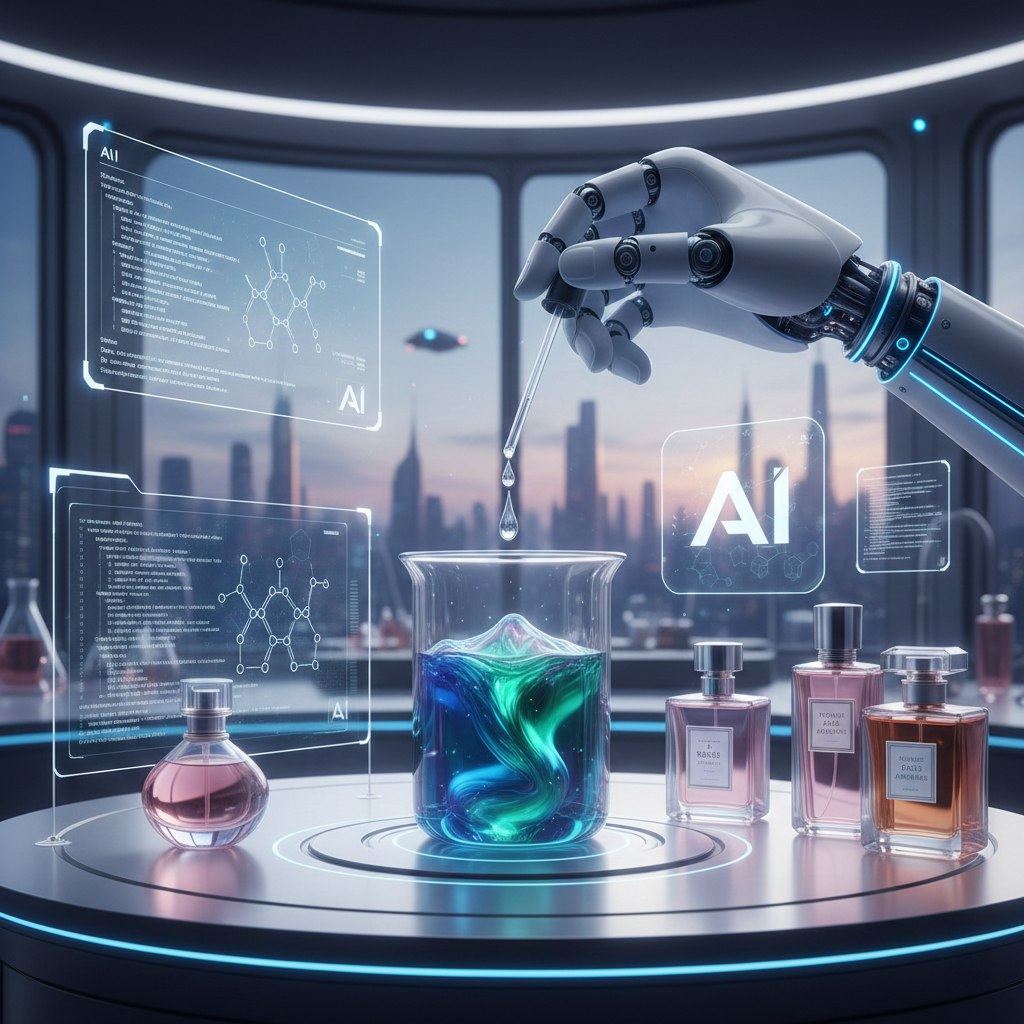
It smells like a revolution. The fragrance industry, worth over 50 billion dollars, and consumer market giants are actively searching for new tools.
Artificial intelligence has become their most promising assistant. But does this mean that the algorithm will soon replace the perfumer? Don’t rush to say goodbye to century-old art.
Fundamentals of Perfumery
- Note — a single scent, for example, jasmine or bergamot
- Chord — a harmonious combination of notes, creating a complex bouquet
- Raw materials — from natural rose oil to complex synthetic molecules
- Brief — technical specification, often poetic («freshness of the morning after the rain»)
- Formula — an exact recipe for creating a fragrance
- Pyramid — a description of how the fragrance unfolds over time
How AI is transforming the industry
The history of perfumery began with alchemists, but today companies like Givaudan use AI, reducing the development of new fragrances from several years to months.
Technological breakthrough
Today, AI is penetrating every stage of fragrance creation:
- Prediction of a molecule’s smell based on its structure
- Generation of new compounds
- Selection of raw materials considering the budget
Ключевые игроки
They clashed on this field.ambitious startups (Osmo, основанный бывшими инженерами Google) и traditional perfume giants (Symrise, Firmenich).
Technological challenges
«To predict the smell of a mixture by knowing only the properties of its individual components is like trying to guess the taste of a complex dish by tasting each ingredient separately.»
Working tools
Scentmate by Symrise
A smart assistant offering affordable alternatives to expensive components
Персонализация Chanel
Creating a unique combination from ready-made chords through an online quiz
AI limitations
AI handles nonlinearity poorly and cannot translate a chemical structure into an emotion. Full autonomy is not yet achievable.
Economic efficiency
Development times are reduced by 70%, and costs—especially for small independent brands.
Coty created its first fragrance using AI in 5 weeks instead of the usual 18 months.
Glossary
IFRA International Fragrance Association, setting safety standards
QSAR/QSPR Methods of Quantitative Forecasting of Substance Properties
ГХ-МС (GC-MS) — Gas Chromatography-Mass Spectrometry Gas chromatograph coupled with a mass spectrometer
Checklist for an AI Brief
- ☑ Raw material constraints: number of components, budget per milliliter
- ☑ Desired character: key notes and chords, emotion
- ☑ Technical framework: compliance with IFRA standards, sustainability requirements
Scents in this story
Mentioned in the story · ULNAY encyclopedia data
 ChanelN 5 L'Eau
Aldehydes meet lemon, neroli, bergamot, mandarin orange, lime and orange in the vivid opening of Chanel N 5 L'Eau. Ylang-ylang, jasmine and May rose preserve a clear floral centre, while white musk, orris root, cedar and vanilla settle into a clean, softly powdered base.
Open in encyclopedia ChanelN 19 Eau de Toilette
Green notes and galbanum give Chanel N 19 Eau de Toilette its crisp, faintly bitter profile. Iris Pallida and powdery notes bring a cool, refined softness, while woody notes add dry structure. Aromatic and balsamic nuances deepen the composition without turning it sweet.
Open in encyclopedia ChanelN 5 Eau de Toilette
Aldehydes, ylang-ylang, neroli, Amalfi lemon and bergamot create a bright opening. Iris, jasmine, rose, orris root and lily-of-the-valley form a powdered floral heart. Musk, sandalwood, oak moss, vetiver, amber, vanilla and patchouli give Chanel N 5 Eau de Toilette its layered woody depth.
Open in encyclopedia GuessSeductive Homme Blue
Cardamom, black pepper, citruses and caviar create a spicy opening with a salty accent. Sea notes and geranium bring cool aromatic clarity, while Cashmirwood, sand and moss form a dry, woody-mineral base.
Open in encyclopedia
Discussion
0 commentsComments use your ULNAY account.
Sign in to comment
It is quiet here. Start the conversation.