Four ways to bring order to your fragrance shelf
A collection becomes tiring when its fragrances lose their roles. A small review will show you what to wear now, what to set aside, and what may be time to let go.
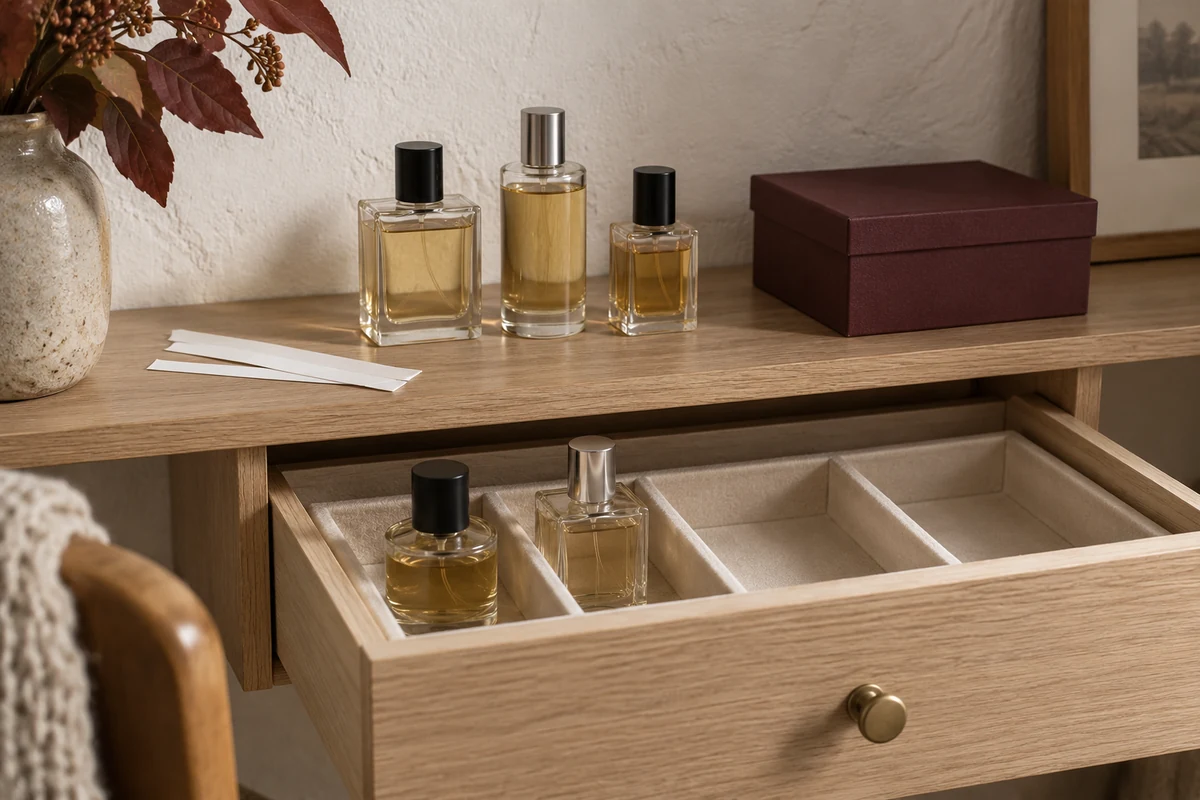
Some mornings, your hand pauses at the shelf: one fragrance suits the day ahead, another suits your coat, and a third was once a favourite but has gone untouched for a long time. You do not need to get rid of half the collection. Start by dividing the bottles into four groups according to the role they actually play in your life.
Begin with a brief inventory
Gather every bottle in one place and note five things for each: its name, the approximate amount remaining, the purchase date or period, when you last wore it, and its original purpose. Perhaps it was meant for hot weather, long walks, evening plans, or a particular mood.
A slight darkening of the liquid does not necessarily mean that a fragrance has lost its olfactory quality. A noticeably altered smell, cloudiness, leakage, a damaged sprayer, or an uncertain provenance matter far more.
After this check, try to describe each fragrance’s role in one sentence. If you cannot, the bottle is probably ready to move into one of the following groups.
1. Keep it if the fragrance still fulfils its role
A shelf needs more than unquestioned favourites. A quiet fragrance can work at close range, a composed one for a working day, a richer one for the evening, and a fresh one in warm weather. Compare similar compositions by the situations in which you would genuinely wear them, rather than by the note pyramids listed online.
A bottle deserves its place if it brings pleasure now, suits a particular occasion, or holds an important personal memory. Rarity and a high price do not make it necessary on their own.
2. Put it away until the season changes if the context has shifted
Citrus, green, marine, and airy floral compositions can sometimes feel tiresome simply because the timing is wrong. Dense amber, gourmand, and resinous fragrances can also wait quietly for cooler weather.
Keep a seasonal box in a dry, cool place, away from direct light and sharp temperature changes. Close the bottles tightly and, where possible, return them to their packaging. A bathroom, windowsill, or shelf beside a radiator is not suitable for storage.
Label the box and note the month for the next review. When the season returns, you can revisit the fragrances without obligation; if your interest does not return, another decision will be easier to make.
3. Give it away if the fragrance is good but not for you
Only pass on a bottle that works properly, has been carefully kept, and has a clear provenance. An opened fragrance can still make a thoughtful gift for someone close to you if you are honest about the approximate amount remaining, how long you have owned it, and why you are parting with it.
It helps to know the recipient’s preferences in advance. Someone who loves clean musks may not enjoy vivid tuberose, while a fan of sweet compositions may find a strict vetiver unappealing. If you do not know another person’s tastes, a miniature or decant is more considerate than a full opened bottle.
4. Sell it if there is demand for the fragrance
This route suits sought-after bottles in good condition, especially when the box, cap, and legible markings remain. Take photographs in daylight and list the name, volume, approximate amount remaining, condition of the sprayer, whether packaging is included, and the known purchase history. An opened fragrance must not be described as new; nor should you promise a particular longevity or identical performance for everyone, as perception is personal.
Rare and expensive bottles require particular transparency. It is better not to sell if you cannot confirm the provenance or if there is visible damage. Before posting an advert, check the rules for private resale and shipping of alcohol-containing products in your country, on the platform, and with the carrier.
What to do with the remaining bottles
A leaking, clearly spoiled, or questionable fragrance should not become a gift or merchandise. Do not try to use it up quickly or pour out the contents thoughtlessly: check your local rules for handling household chemical products.
After a review, the shelf may become smaller, yet much more enjoyable to use. What remains will be fragrances with their own time, distance, and mood: a collection that is easy to wear, sensible to add to, and easy to love again.
Scents in this story
Mentioned in the story · ULNAY encyclopedia data


Share this story
Discussion
0 commentsComments use your ULNAY account.
Sign in to comment
It is quiet here. Start the conversation.