RIFM to Present a New Approach to Assessing Respiratory Risks at LIVe2026
With LIVe2026 just days away, RIFM has announced a presentation on hypothesis-driven screening of potential respiratory sensitizers. It is a professional method for assessing the safety of fragrance materials, not a new rule for choosing finished perfumes.
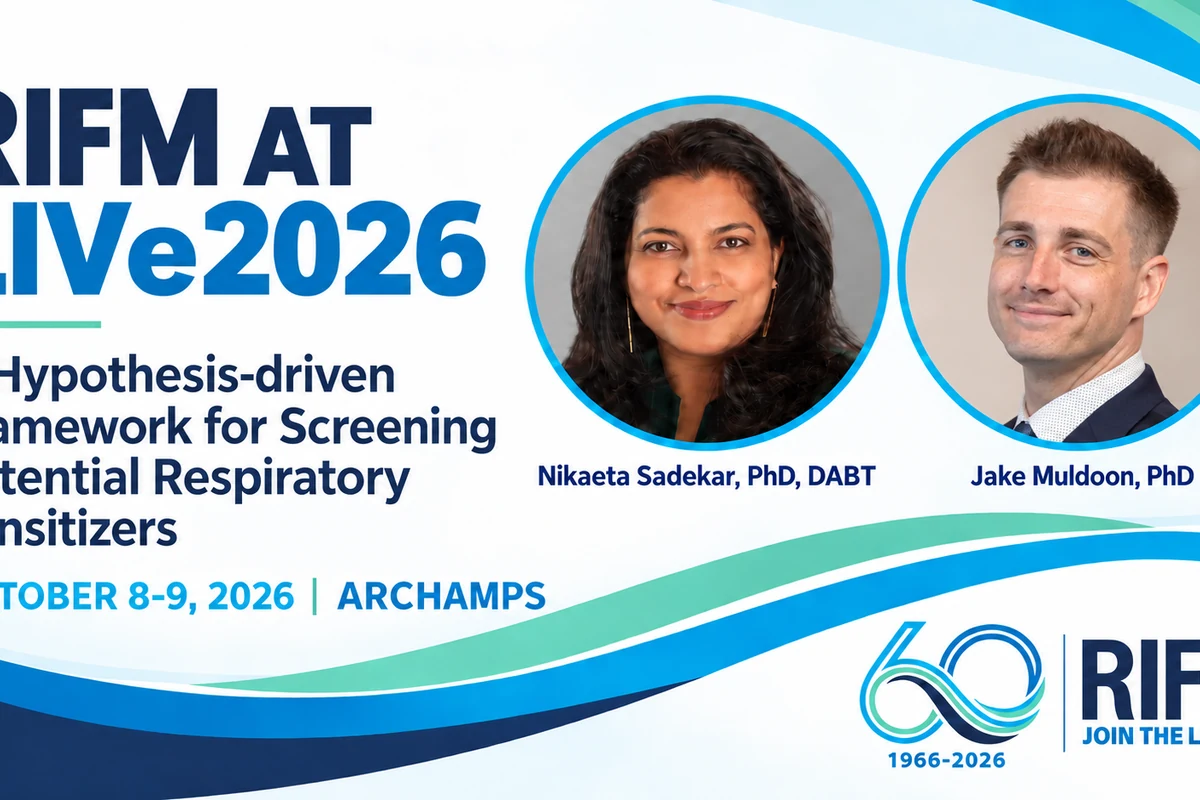
When fragrance safety is discussed, the brief word ‘screening’ usually stands for a long chain of scientific decisions: which properties of a substance to study, which models to use, and how to interpret the result. This is the reasoning the Research Institute for Fragrance Materials intends to bring to LIVe2026.
The Lung In Vitro Event, or LIVe2026, will take place in Archamps, France, on 8–9 October. Its programme focuses on research into the respiratory system outside the body, including lung-tissue models, inhalation toxicology and regulatory questions. Against this backdrop, RIFM will present its approach to the early identification of substances that may be potential respiratory sensitizers.
The presentation will be given by Nikaeta Sadekar, PhD, DABT, and Jake Muldoon, PhD. The institute describes the proposed scheme as a hypothesis-driven framework: a system in which the sequence of assessments is built around pre-formulated scientific hypotheses rather than a single universal test.
For the fragrance industry, this is an important shift in how the question is framed. Assessing the safety of a fragrance material requires more than recording an isolated laboratory signal; it also means understanding how relevant that signal is to a real-world scenario of respiratory exposure. This makes LIVe2026, with its focus on in vitro respiratory-system models, a particularly fitting setting.
For now, this is an upcoming presentation of a method, not a new restriction on specific ingredients or a change to formulas on shop shelves. Consumers should not draw conclusions about the safety of a perfume bottle from this announcement. For toxicologists, fragrance developers and anyone following the scientific side of perfumery, however, the talk will offer a chance to see how RIFM plans to refine its tools for preliminary assessment.
Methods like these rarely produce a headline result in a single day. Their value lies in making the link between laboratory-model data, a risk hypothesis and the next research step more transparent. Further details of the framework, its limits and the outcomes of the discussion are expected after the congress.

Share this story
Discussion
0 commentsComments use your ULNAY account.
Sign in to comment
It is quiet here. Start the conversation.