Olive in Perfumery: From Bitter Leaf to Salty Oil
The olive note has yet to become mainstream, but several contemporary fragrances already reveal its unusual range—from dry greenery and wood to sea salt and warm oil.
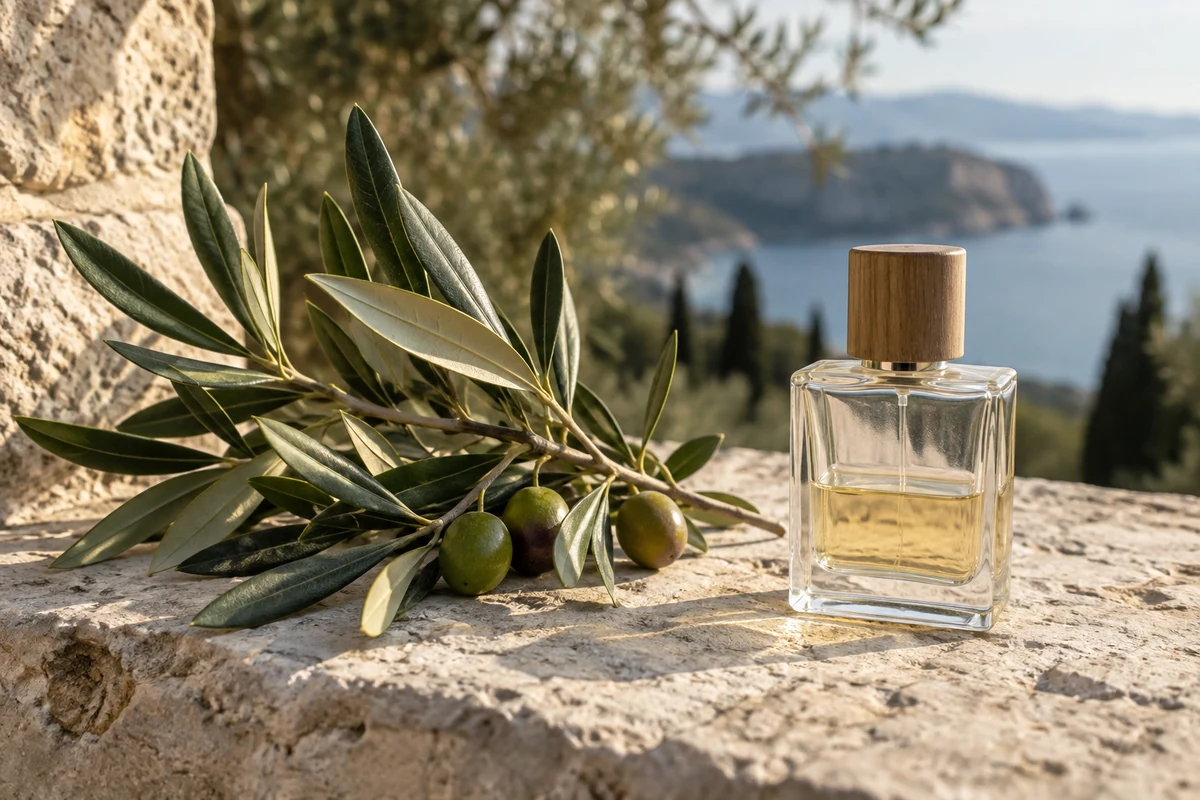
The word “olive” does not suggest one obvious scent. Some imagine a freshly split green fruit; others, sun-warmed wood or an astringent leaf with a silvery underside. Perfumers draw on all these images, so two bottles listing olive in their note pyramids can smell entirely different.
What Exactly Smells Like Olive?
Fresh olive leaf gives a grassy, cool and slightly bitter impression. The wood takes a composition towards dry, quiet warmth, while the idea of the fruit or oil adds gentle salinity, a nutty nuance and an almost culinary richness.
The name of a note does not always mean that the bottle contains an extract from a particular part of the plant. It is often an accord—an illusion assembled by the perfumer from several materials. This is why olive so often appears beside fig, herbs, pepper, vetiver, resins and sea salt: they help bring out the desired facet of the tree.
Natural olive materials do exist. Olive leaf absolute, for example, is described as a fresh, grassy scent with a fruity nuance and pronounced bitterness. Yet a note pyramid alone cannot reveal whether such an extract or a perfumer’s interpretation of it was used.
Dry Greenery and Pale Wood
One of the clearest examples is Hermès Un Jardin à Cythère. The house combines olive wood with golden grasses and fresh pistachio. The result is not a lush green garden but a dry, almost sun-bleached landscape: warm earth, brittle stems and smooth wood beneath the sun.
The Italian house LabSolue takes a similar direction in 201 Ulivo. Here, olive wood is surrounded by vetiver and cistus. These notes deepen the composition’s earthiness, smoky dryness and resinous character without turning it into a literal rendering of an olive grove.
In fragrances like these, olive works almost as a new kind of woody accent. It is less creamy than sandalwood and less austere than cedar. Its character rests on the contrast between silvery greenery and sun-warmed bark.
Olive by the Sea
The most expressive salty interpretation appears in Arquiste A Grove by the Sea. Its official note pyramid lists black olive, an olive oil accord and fleur de sel. They are joined by fig leaf and fruit, rosemary, thyme, pine needles and cypress.
Here, the culinary suggestion does not lead to sweetness. The oily quality softens the sharp herbs, salt makes the greenery more translucent, and pine needles and red clay preserve the feeling of an open Mediterranean landscape. It is a rare case in which a house explicitly presents both the fruit and the oil rather than settling for an abstract “olive tree.”
Ôrebella Salted Muse offers a softer, more tactile variation. Sea salt and pink pepper open the composition; an olive tree accord with fig and lavender appears in the heart, while cedar, sandalwood and amber shape the drydown. Olive becomes a bridge between mineral freshness and a warm woody base.
Both fragrances reveal an important quality of the note: saltiness does not have to smell like a conventional aquatic perfume. Paired with olive, it can evoke heated stone, dry herbs and faintly bitter oil.
A New Accent: A Special Extract Rather Than an Accord
For L’Objet Delphes, perfumer Jean-Claude Ellena built the composition around Olive Grignon Absolute. According to the brand, the material is obtained from the branches, leaves and fruit of the olive tree. Black pepper, violet leaf, cedar, patchouli, sandalwood and oakmoss accompany it.
This setting reveals olive without an overt seaside backdrop. Pepper and violet leaf emphasise its coolness, woods provide structure, and moss adds a muted shade. The resulting olive impression occupies the space between the green and woody fragrance families.
Delphes is particularly significant to the development of this theme: the house speaks not only of the idea of olive but also of a specially created extract made from different parts of the tree. Only a side-by-side comparison can show how noticeably it differs from a skilfully constructed accord, but the approach itself broadens the perfumer’s working palette.
How to Read an Olive Note Pyramid
The words surrounding olive usually predict a fragrance’s character more accurately than the note’s name alone. Leaf, violet, vetiver and cypress suggest dry greenery. Salt, fig and rosemary steer the composition towards the coast, while sandalwood, amber and resins make it warmer and softer.
The specified part of the plant matters too. “Olive leaf” generally points to grassy bitterness, “olive wood” to dry woody depth, and “fruit” or “oil” to a rounder, more piquant impression. These are useful guides rather than strict rules: the complete formula determines the final scent.
A useful introduction to the note is to compare two opposing interpretations—one dry and woody, for example, and another salty and herbal. A blotter makes the composition’s structure easier to discern, while skin reveals whether its oily or bitter facet moves to the foreground.
An Experiment That Has Already Found Its Form
Olive remains a rare motif, so it is too early to call it a widespread new standard. Yet it is no longer a one-off fantasy: current catalogues contain woody, green and salty interpretations, while recent writing on perfumery identifies them as a group in their own right.
Its appeal lies in the absence of an established cliché. Olive can smell neither like food nor like a familiar cologne, but like an entire landscape: silvery leaves, warm bark, stone beside the water and air in which salt mingles with herbs. That freedom is precisely what makes the note worthy of attention.

Discussion
0 commentsComments use your ULNAY account.
Sign in to comment
It is quiet here. Start the conversation.