Perfume with Skincare Promises: How to Read a Hybrid Product Description
Words such as “niacinamide,” “camellia oil,” and “24-hour hydration” can make a fragrance sound like a serum. Yet the ingredient list, test results, and fragrance description answer different questions—and should be assessed separately.
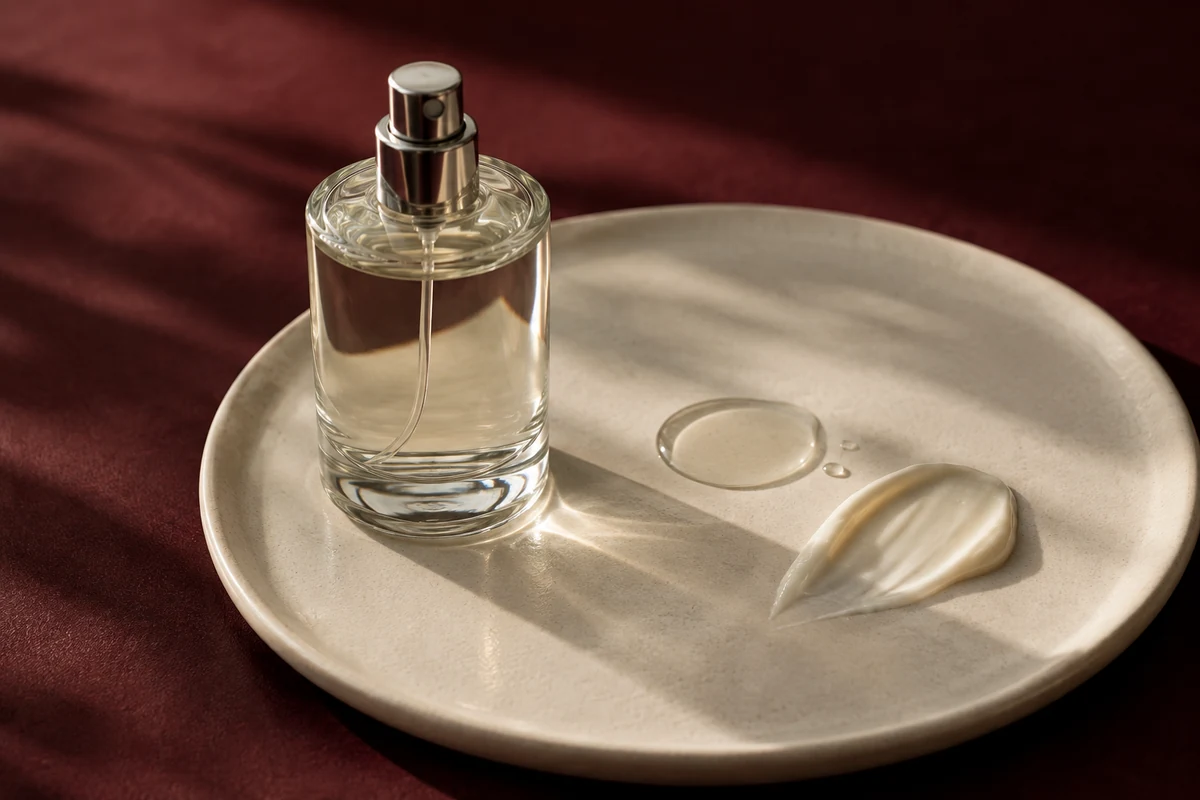
The droplets have dried, the scent remains, and the skin feels softer—a hybrid product can easily seem like both perfume and a complete treatment. Sometimes the formula genuinely performs both functions. But a pleasant feel after application, the presence of a fashionable ingredient, and a measured effect are not the same thing.
First, identify exactly what the bottle promises
Descriptions of these products usually blend three kinds of language. Fragrance language evokes lemon zest, jasmine, damp woods, or clean musk. Sensory language promises a weightless mist, silkiness, and no sticky residue. Cosmetic language speaks of hydration, strengthening the skin barrier, adding shine to hair, or protecting it from breakage.
The first two layers help you imagine the pleasure of using the product. They depend greatly on perception: one person may smell dry tea, another powder and warm woods. A cosmetic claim is held to a stricter standard because it describes what the finished product does and should be supported by appropriate evidence.
Fragrance “notes” should not be read as a list of raw materials. Peach, cashmere, or sea air may refer to an accord created by the perfumer rather than the literal presence of a corresponding extract. The INCI list on the box or bottle is the record of the product’s actual ingredients.
An ingredient confirms the formula, not the full effect
Brands often highlight niacinamide, glycerin, biotin, hyaluronic acid, or a botanical oil on the front of the packaging. Finding the advertised ingredient in the INCI list is useful: it confirms that the ingredient was indeed added. The next question is whether the performance of the complete formula was tested.
Under EU rules, the properties of an individual ingredient cannot automatically be attributed to the finished product. Niacinamide may be well studied in cosmetics, but its presence alone does not prove that a particular fragrance mist will noticeably strengthen the skin barrier. The result depends on its concentration, the product base, the method of application, and interactions among the ingredients.
An ingredient’s position in the INCI list offers only a rough guide. On European cosmetics, ingredients are listed in descending order by weight, but substances present at concentrations below one percent may appear in any order after those used at higher concentrations. An ingredient near the end is therefore not necessarily ineffective, while a place near the beginning is no substitute for efficacy testing.
The word Parfum or Fragrance may also represent a composition containing several aromatic substances. Some recognised fragrance allergens must be listed separately when they exceed prescribed thresholds. European disclosure requirements are now expanding, so ingredient lists may differ between older and newer packaging; the list on the box of the product you purchased remains the relevant one.
What real products reveal
Rare Beauty describes Find Comfort Body & Hair Fragrance Mist as a scented mist with niacinamide, biotin, and peach flower extract. These ingredients appear in the published INCI list, while the brand also makes separate claims about soft skin, shine, and hydrated hair. Here, it is easy to distinguish a confirmed fact—the presence of the ingredients—from broader performance claims, which require information about testing of the finished formula.
Diptyque’s Fleur de Peau hair mist is said to contain nourishing, protective camellia oil. The oil does appear in the ingredient list. Yet the list alone cannot tell us how substantial that conditioning effect will be compared with an ordinary conditioner or leave-in hair treatment.
Dior describes J’adore Parfum d’eau as an alcohol-free, water-based formula and publishes an ingredient list in which water comes first and ethanol does not appear. This is a readily verifiable feature of the format. Glycerin and glycols may influence how the product feels on application, but the brand does not treat their mere presence as proof of intensive care. An alcohol-free formula also cannot guarantee that an individual will not react to its fragrance materials.
These examples do not divide products into “honest” and “dishonest” categories. They show that different statements call for different kinds of verification: the ingredient list confirms what is in the formula, a test supports its effects, and the description of the notes conveys the creative concept.
How to read test results
A specific claim such as “hydrates for 24 hours” is more useful than the general promise that a product “cares for” the skin, provided the brand explains how it obtained the result. The most informative product pages state the duration of the test, the number of participants, the conditions of use, and the assessment method.
An instrumental study records a measurable change in the skin or hair. An expert assessment evaluates the result against predetermined criteria. A consumer test reports how many participants noticed softness, shine, or comfort. This last format captures people’s impressions well, but “100% noticed hydration” is not equivalent to a direct measurement of moisture levels.
The fine print matters too. A result observed after one use cannot be extended to long-term care, while data from using a mist together with a lotion cannot be attributed to the mist alone. If the page does not disclose the methodology, an advertising line is not enough to judge how convincing the figure is.
Terms that need clarification
“Water-based” describes the type of formula, not the strength of its hydrating effect. “Alcohol-free” usually means that the product contains no ethanol, but it does not make the formula universally suitable for sensitive skin. “Contains antioxidants” describes its ingredients; a claim that the product protects the skin from a particular external stressor requires evidence from the finished formula.
Phrases such as “refreshes,” “brings comfort,” and “wraps you in softness” usually describe a sensation or mood. There is nothing misleading about them as long as evocative language does not stand in for a measurable claim. Terms such as “natural,” “clean,” or “vegan” may describe the formula’s origins or the brand’s values, but they do not prove hydration or tolerance.
Check the intended application area as well. A product for the hair and body is not meant for the face unless the manufacturer explicitly says so. A biphasic mist needs to be shaken; otherwise, the proportion of its water and oil phases may vary with each spray. Here, the directions are part of how the formula works, not a formality.
When a hybrid product is genuinely useful
A fragrance mist can be a good everyday product when you want a light scent, pleasant slip, and a modest softening effect on the skin or hair. It can replace a richer cream, serum, or conditioner only when its purpose is comparable and the effect has been demonstrated for the formula itself.
Before buying, simply match each promise with the right kind of evidence. Notes and the character of the scent trail are best assessed on your skin or hair. Ingredients should be checked against the current INCI list. Claims about hydration, strengthening, and protection should be considered alongside test data and the exact conditions under which the results were obtained.
This way, there is no need either to overestimate a hybrid product or dismiss it as an empty marketing exercise. It remains what it should be: a fragrance with a clear additional benefit whose value can be found beyond the beautiful words.
Scents in this story
Mentioned in the story · ULNAY encyclopedia data
 BenefitRing My Bella
ringmybella opens in a clear floral sweep of lily, rose and daisy. Peony and jasmine expand the bouquet without disturbing its fresh, open character, while musk and vanilla soften its edges. Patchouli gives the base a quieter sense of depth, leaving the flowers bright yet gently grounded.
Open in encyclopedia BenefitSo Hooked on Carmella
Rhubarb, lemon and grapefruit bring a brisk, tart opening before tiare flower, cyclamen and peony soften the edges. Vanilla and amber lend sweetness and powdery warmth, while sandalwood gives the drydown a smooth woody line. The result balances brightness with comfort without losing its sense of air.
Open in encyclopedia BenefitLaugh with me Lee Lee
A cool rush of melon and citrus is sharpened by the green nuance of currant leaf and bud. Lily and jasmine bring an airy white-floral presence, with violet adding a softer floral shade. Sandalwood, woody notes and amber lend calm depth without obscuring the fragrance's fresh, lucid character.
Open in encyclopedia BenefitUnder My Spell Noelle
Cardamom and pepper open with aromatic heat, cut by the tart brightness of cranberry. Vanilla softens a floral heart of rose, orchid, violet and jasmine, while oud, patchouli and benzoin deepen the base. Raspberry adds another vivid berry accent to the warm, sweet and shadowed composition.
Open in encyclopedia
Share this story
Discussion
0 commentsComments use your ULNAY account.
Sign in to comment
It is quiet here. Start the conversation.