Which notes will lose their relevance in the next five years?
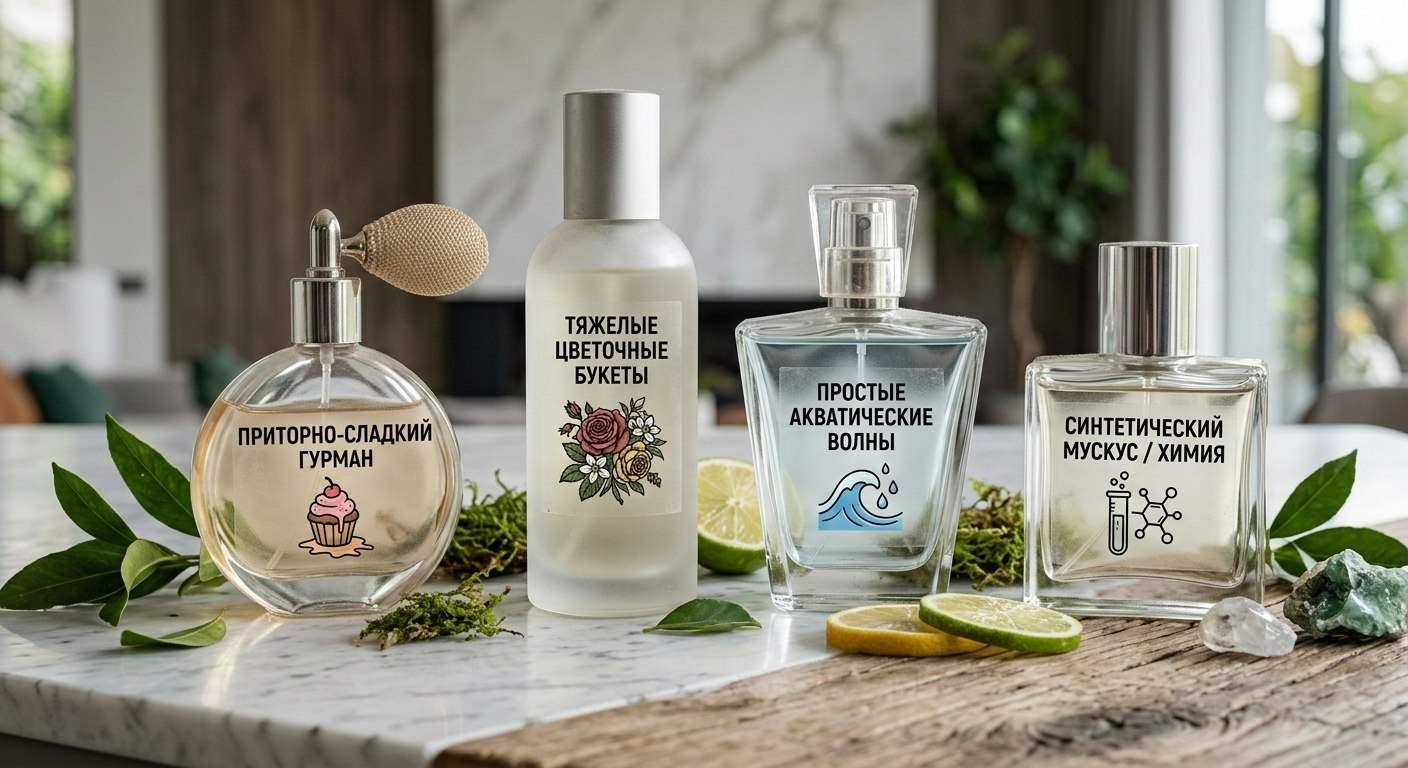
We can expect a noticeable cooling of interest in entire families of fragrances.
Fading Trends: What Is Losing Popularity
The first to be at risk —ultra-sweet gourmet notes Like ethyl maltol, caramel, or cotton candy. Their time is passing along with the era of dessert «bombs.» A similar fate will likely be shared by synthetic «medicinal» cherry and its liqueur variants, especially in the mass market segment. They are already being replaced by more subtle and complex interpretations.
Heavy animalic notes and smoky chords are also losing ground. Castoreum, civet, or birch tar now seem too intense and contrary to the overall trend towards purity and lightness. Even once-popular marine accents, such as calone or cucumber notes, are today associated with the outdated freshness of early 2000s perfumery.
A separate story is mass-market templates. The combination of pear, peony, and pink pepper has become a recognizable cliché. The same excess is felt with overdoses of ambroxan and ISO E Super, creating an intrusive rather than elegant trail. The market is oversaturated, and consumers are tired of the obvious.
Why does this happen? Reasons for changing trends
There are several key drivers:
- Market saturation — People look for one perfume for all occasions, not niche «heavyweights.»
- The Influence of Ecology and Ethics — There is a growing demand for traceable and biodegradable raw materials
- Climate Change — Physical heat makes dense trains uncomfortable.
- Digital Culture — Social networks quickly spread the hype, but also quickly kill the hype around the notes.
- Regulatory restrictions — IFRA and the European Union are gradually phasing out classic components
Transformation Instead of Disappearance: What Will Happen to the Classics?
Many basic notes will not disappear, but will change drastically:
Vanilla
It will move from simple sweetness to salty, woody, or smoky interpretations in the company of frankincense.
Citrus fruits
They will become more abstract — biotechnological reconstructions of zest or elusive «skin» chords
Rose and white flowers
The powdery overtones will be shed, becoming tea, green, or watery.
Geography and generations: whose trend is it?
Trends will vary greatly by region:
West
A request for gender-neutrality, purity, and «quiet» scents for the skin
Middle East and South Asia
The traditional love for intense sweet and oriental compositions will remain.
Asian market
Will focus on ultra-light airy chords, clean musks, and watery notes
What should brands do? Practical steps
- Critical portfolio audit — evaluation of dependence on sugary gourmet notes and outdated aquatics
- Development of substitution strategies — creation of new hybrids at the intersection of natural extracts and biotechnological analogues
- Revisiting Approaches to Testing — blind testing in real conditions and metrics monitoring
The outcome is predictable.
We are moving towards greater minimalism, lightness, and mindfulness in the choice of fragrances. Loud, intrusive, and obvious notes are losing ground. The future belongs to subtle, complex, and comfortable compositions that sound like a natural extension of the skin, rather than a loud statement.
This is not the death of trends, but their maturation.
Scents in this story
Mentioned in the story · ULNAY encyclopedia data


Discussion
0 commentsComments use your ULNAY account.
Sign in to comment
It is quiet here. Start the conversation.